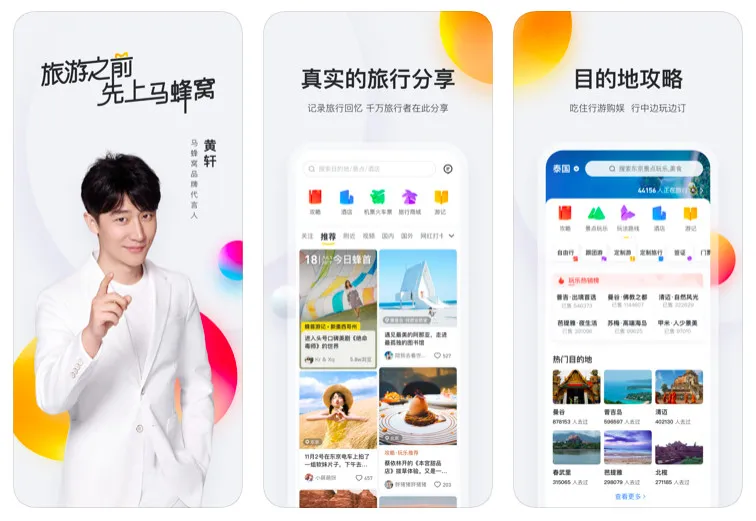
Social Media influences Chinese travellers
Through social media sites, the Chinese population collects all kinds of information about products, services, and destinations before making their final traveling decisions.
Social networks have become an essential and powerful source of information for Chinese tourists.
Generally speaking, Chinese citizens spend a large amount of their time online, mainly on social networks and online entertainment. According to AT Kearney, a management consultancy, Chinese users spend 47% of their time on social networks while they spend 35% of their time on online entertainment.
Chinese users also dedicate part of their online time to other activities such as shopping and financial services.

The engagement of American consumers on diverse social media platforms except Facebook is lower, in comparison to Chinese users who have a higher engagement across many Chinese social networks such as Qzone, Weibo, WeChat ,and Tencent QQ. However, companies must keep in mind that having a social network account does not ensure engagement.
Expert Tips: What are the right channels to get the attention of Chinese tourists?
1. Chinese social media – WeChat, Weibo, Red, Douyin
2. Chinese OTA’s – CTrip, Qunar, Quyer, Fliggy
3. Chinese search engines – Baidu, So
4. Chinese Travelling Influencers (KOLs)
5. Chinese travel blogs and forums
The four social networks in China with more users and highest engagement are Qzone, Weibo, WeChat, and Tencent QQ.
QZone is one of the most popular social platforms in China with more than 600 million users. Through this platform, users can write blogs, watch videos, send photos, and listen to music. Qzone has become the social network with the largest number of active users with an amount of 68 to 80 percent of all its users connected daily.
Fundamentals of QQ Advertising in China
Tencent QQ is an instant messaging platform with more than 800 million monthly active users. QQ offers social games, music, shopping, microblogging, and group and voice chat.
However here, it is mostly about showing big numbers since every single user connected on QQ is also considered as connected to QZone since the two services are very tightly linked.
The network to pay attention to is WeChat, also from the Tencent group
WeChat is a powerful messaging application which also includes video calling, mini-games, location-based services, brands’ stores, and a payment system? WeChat has 800 million monthly active users. WeChat is used by tourists to share real-time their experience, their pictures, or their feeling about anything only with the people they are connected directly to.
Ultimate Guide To WeChat Advertising & Growth
Needless to say, they will take pictures of your rooms, if you are a hotel, your tour if you are a tour operator, and then share them.
Weibo: great to stay close to your customers and have a global interaction
Weibo is another successful social network in China. Sina Weibo is a microblogging website with more than 500 million users where Chinese members can write posts of 140 characters including videos, pictures, and links.
A Guide to Weibo Paid Advertising
According to AT Kearney’s study the influence of social media platforms on buying decisions depends on the consumers’ age. While two-thirds of the study’s interviewees younger than 35 affirm that they often base their purchase decisions on opinions, comments, and information that they find on social networks, over 80 percent of interviewees 65 and older say that they hardly or never have based their purchase decision based on the content coming from social networks.
China is a web 2.0 country
China has more than 1 billion internet users and around 95 percent of them have at least one account on a social media site. In addition, the Chinese are the most active social media users in the world.
The reality is that Chinese travelers are more willing to decide the destination, hotels, and activities of their holidays that are mentioned and recommended on social media networks.
Hotel Registration & Chinese OTA Agency
Chinese tourists put more trust into word-of-mouth information from friends, family, and key opinion leaders as well as content shared on social media networks than in the information that official sites and advertising campaigns offer.
China’s social media usage continues to increase rapidly, therefore companies must learn how to tap those platforms to influence the tourists’ choices in their favor.
If you are interested to take advantage of Chinese social media platforms to reach more Chinese tourists, we know how to do it. Let us know!
Want to attract Chinese tourists on Social Media?
We are Experts in Chinese E-Tourism!
 Contact us now to get a Free Consultation or a Well-crafted Campaign.








2 Comments