International Hotels in China Should invest more in Digital Marketing
China’s tourism consumption demand is strong in 2019. Chinese tourists are more and more concerned about culture, creativity, the fusion of science and technology.
Outbound tourism is increasing in China. Chinese tourists spend $127.5 billion on outbound travel in 2019.
The outbound tourism market in China
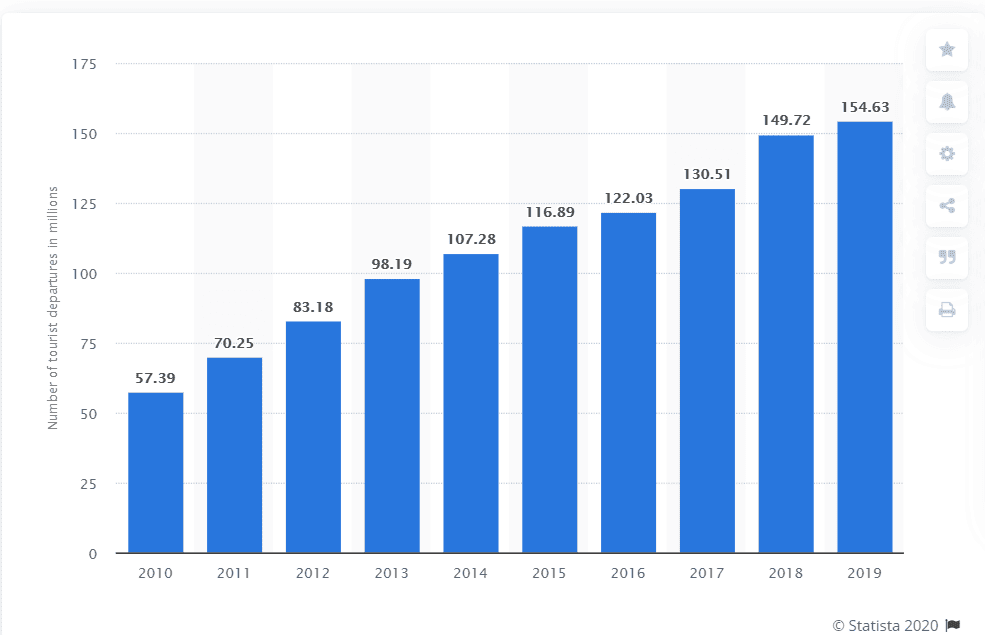
169.21 million outbound trips were made by Chinese tourists in 2019, up 4.5 percent from the previous year, according to a report released by the National Bureau of Statistics.
The foreign spending of Chinese tourists in 2019 was equal to 115.290 billion dollars. Furthermore, as the China Tourist Academy (CTA) reports, the expenditure per capita is around 800 dollars and the number of travelers has expanded in consideration of the fact that those who hold the passport have exceeded 10%.
According to data collected by Ctrip and other independent surveys, the top ten cities for average per capita spending by Chinese tourists in 2018 have been Beijing, Shanghai, Suzhou, Shenyang, Changchun, Dalian, Qingdao, Guiyang, Jinan, and Wenzhou. Average per capita spending in Beijing, in at the top of the table was 6,817 Rmb.
Chinese travelers are spending more on outbound travel than on domestic travel. The per capita annual consumption of outbound tourists also increased by 8% year-on-year. This is mainly due to the high consumption of the post-80s people, but the rapid growth of the post-1995 people is also a big driving force of the Chinese tourism market, which is expected to become the main force of the future tourism market. This shows that with the continuous improvement of Chinese people’s living standards, outbound leisure tourism will increase.
So if you want to grasp this chance to promote your travel products, especially your hotel, you need to follow the trend in China and have a deep understanding of Chinese customers.
How to promote your hotels via digital marketing?
Work on SEO(search engine optimization) on Baidu
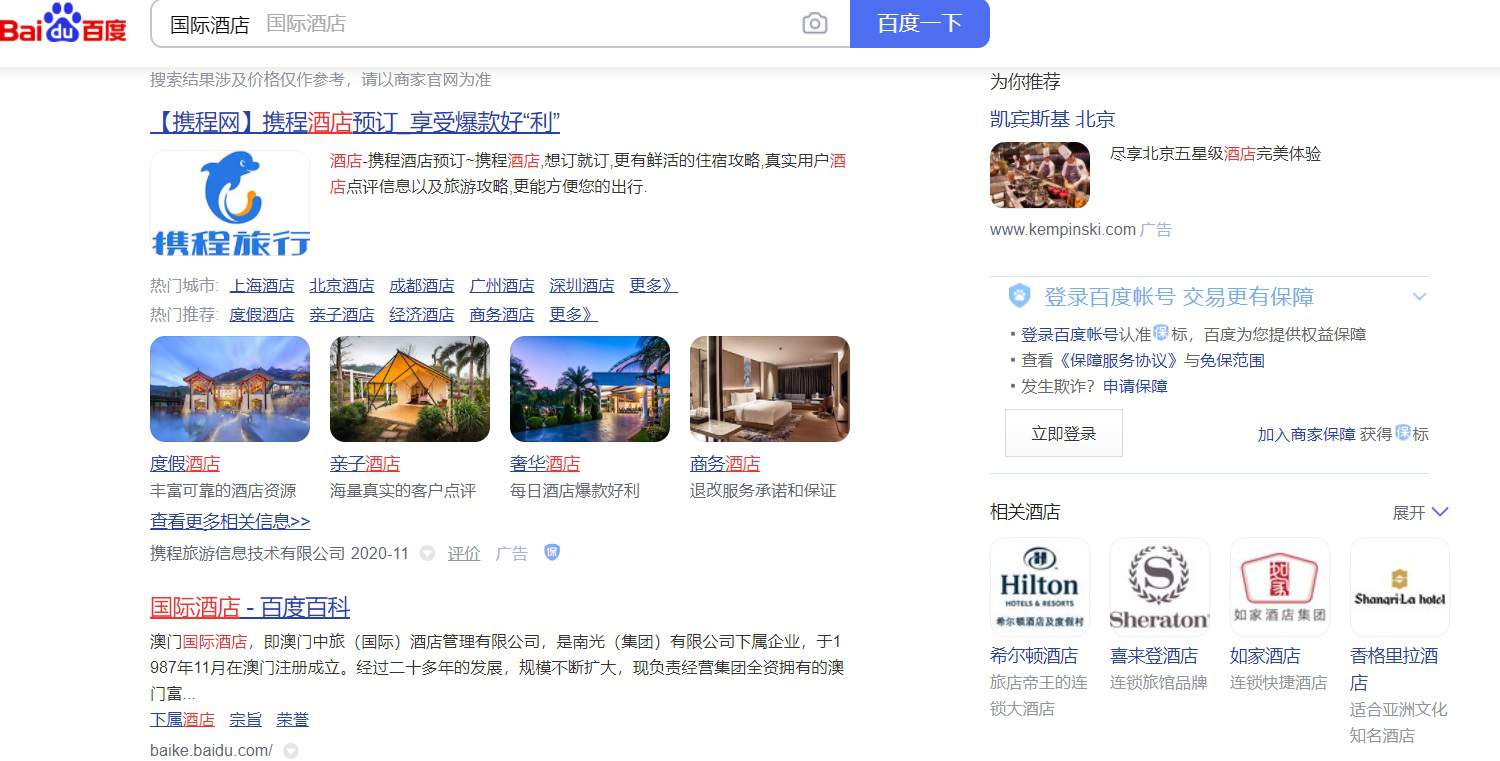
The first step to getting Chinese consumers to choose your brand is to build a good reputation in their hearts. In the context of the rapid development of the Internet in China, consumers usually use the Internet to look for and understand products and brand information and to judge whether a brand has a good reputation or not. This is when your e-reputation becomes important. You need to optimize the content of your website on Baidu to keep it on the first page of Baidu keyword search results.
All you need to do is to select some keywords that can represent your brand’s value and characteristics. For example, if you want Chinese customers to choose your luxury hotel, you need to choose some keywords, such as “comfortable rooms”, “with good views”.
Secondly, you need to keep the content updated and adjust it based on the latest trend. The important thing is to get your potential clients and build a good reputation in the long-term.
PR to give legitimacy to your website
PR is a marketing tool that excludes Paid ads. It consists of having an authority profile talking about your company. It can be media (newspapers, blog), KOLs or even the community.
PR has the advantage of lasting in time and gives you legitimacy.
Use Social Media to reach your target customers
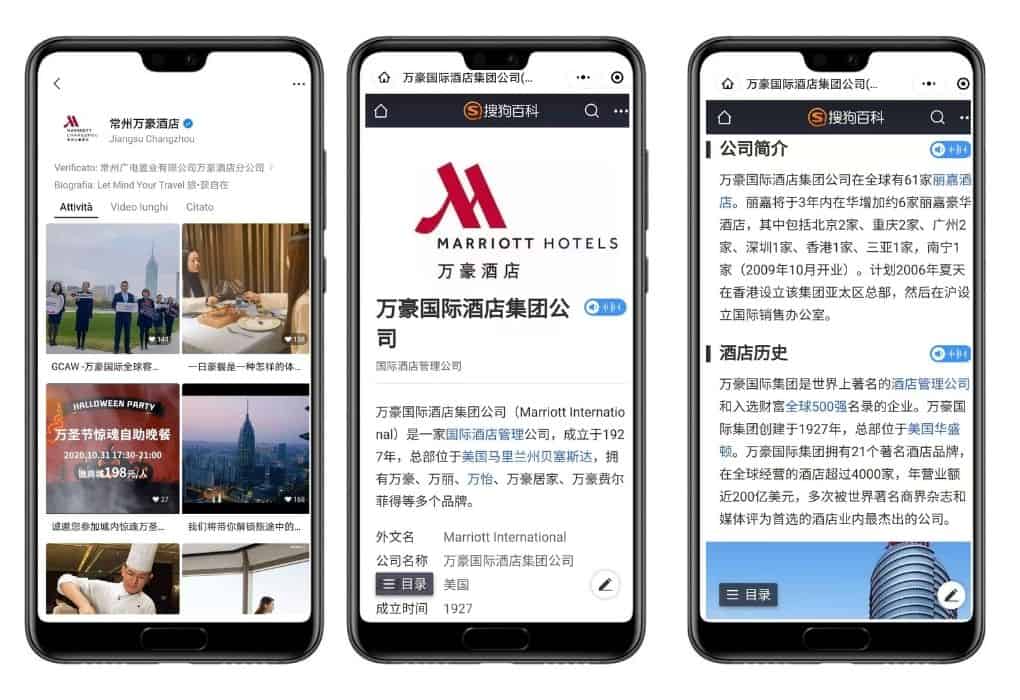
More and more Chinese people use social media such as Wechat and Weibo to connect and interact with their family and friends. WeChat for example, with more than 1 billion monthly active users, is with no doubts one of the most influential platforms among Chinese social media. So if you take full advantage of WeChat you can attract your target customers.
For a company it is really important to have an official account in order to attract clients, to send push notifications, to have more followers and to redirect users in their website. Selecting the official account, the users can see the last items.
The articles in Wechat are presented like newsletters that the users receive. The design must be captivating and well-finished.
It is better to create a located content, in line with Chinese tastes. There are three kinds of advertising on Wechat: moments, Kols (an agreement between an advertiser and a popular blogger that will be paid for the creation of advertising content in the form of a newsletter), and banner (it is an announcement that appears at the bottom of the article mode of another official account. It uses the same targeting system as WeChat Moments ad).
The moment circle is a great place to connect with your customers. WeChat has been allowing brands to advertise on Moments since 2014. Brands like BMW, Coca-Cola, and Vivo mobile phones all once put up Moments ads. They can define their target users based on gender, age, location, occupation, preferences, consumer behavior, etc. Therefore, it is much more accurate.
Moments ads usually present in the form of texts, pictures or a video, along with promotional campaigns or giveaways. If readers are interested, they can click the “Read More” button at the lower-left corner for more information, which is usually linked to a promotional post, and H5 campaign page, the brand’s official account or its official website.
Choose to work with KOLs on platforms like Douyin
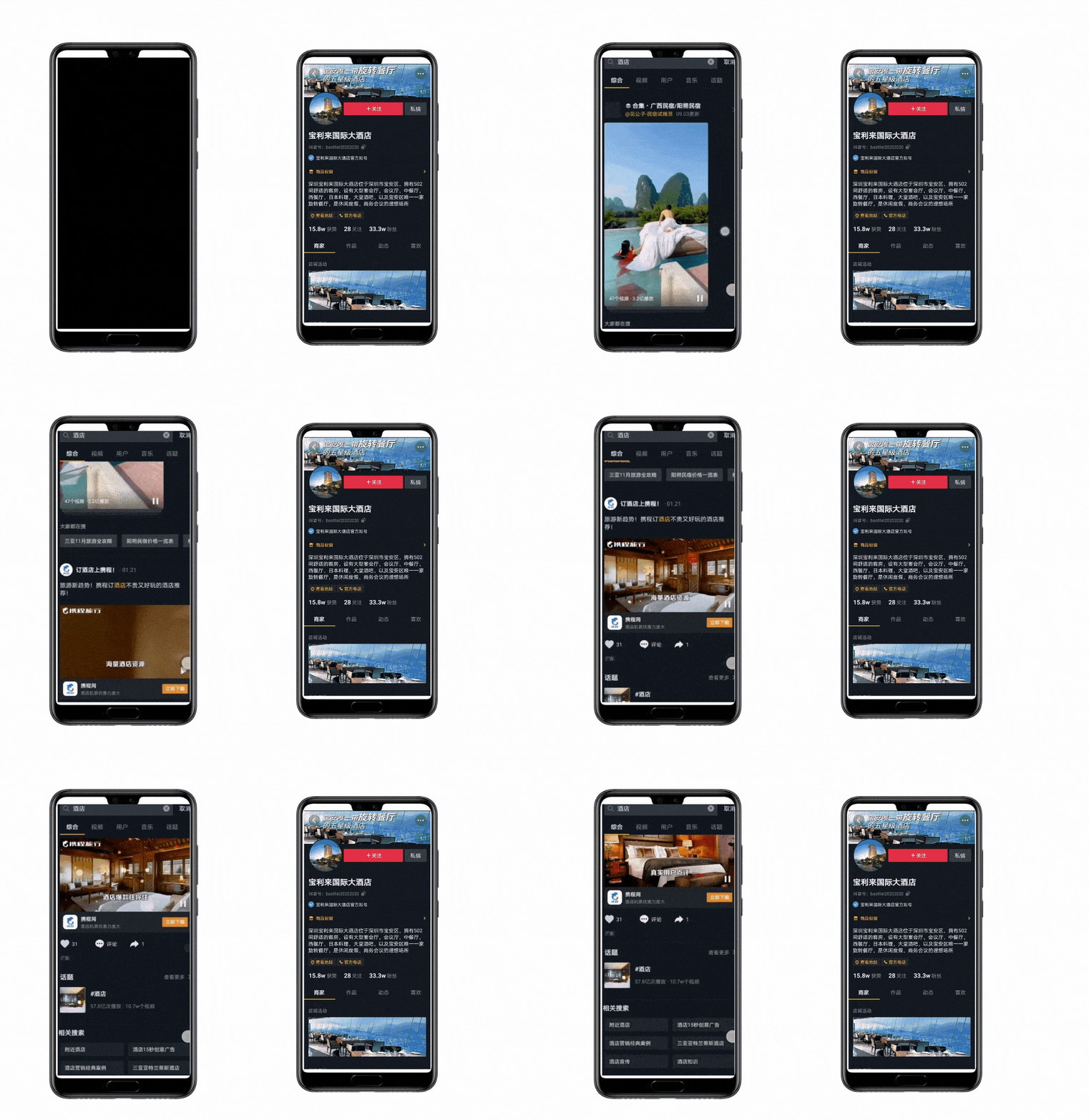
KOLs have gradually developed into an influential group in China. They have a large number of fans, and their purchase behavior will affect the purchase behavior of their followers. And it’s important to note that choosing these people as your KOL is far cheaper than having a star as your spokesmen.
KOLs allow companies to position their brand and reach a huge audience. Not only do they encourage followers to reply and comment, but they also play a very important role in convincing the user to become a consumer.
This is like word-of-mouth marketing and can make their fans to purchase the same products. For example, if you choose your appropriate KOL in social media, they will post information and pictures of your hotel and recommend them to their fans. Since their fans trust them so much, they are likely to choose your brand when considering foreign hotels.
It is also possible to partner with KOLs who have a very large number of followers on streaming platforms or on channels like AcFun and Bilibili.You can collaborate by asking them to make short films or interesting documentaries about the brand.
Very often celebrities become exclusive ambassadors for a particular brand. The challenge lies in convincing a popular KOL to lend their face exclusively for one brand.
In China, there are many online holidays, such as Single Day for example. During these occasions, it is possible to collaborate with a KOL to direct a digital event of one day or more, to promote and increase knowledge of the company’s products/services.
Since finding the right Kol can be really difficult, contact us and we will find the perfect person for you.

GMA is an expert in Chinese digital marketing since 2012. We have worked with many big or small brands with our expertise in SEO, social media marketing, PR, etc.
Read also:
- How to promote a luxury resort to Chinese tourists?
- How to find a good Chinese Tour Partner in 2020?
- The tourism industry in a bad patch in 2020