How to promote your destination to Chinese Tourists with Fliggy?
Fliggy, also known as AliTravel, is Alibaba’s online travel platform. For hotels, destinations and tour operators it is one of the most important booking channels in China. It plugs straight into Alipay, used by hundreds of millions of Chinese consumers daily, so international travel brands get a very active, mobile-first audience. If you want to promote your destination to Chinese tourists, Fliggy belongs in the plan. It works best next to the right social media and reputation work, though, and I would not put it first.
Below, the steps in the order I would take them.
Step 1: know who the Chinese tourist is in 2026
The Chinese outbound market is large and mixed. Millennials now make up the biggest share of independent travelers, and they travel nothing like the group-tour generation before them. They research a lot online. They share the trip in real time on Douyin and Xiaohongshu. They expect mobile payment everywhere. Senior travelers are a growing segment too, often after comfortable, health-focused and photo-friendly experiences.
In 2019, Chinese travelers took 154.6 million trips abroad and spent nearly $255 billion, according to the UN World Tourism Organization. Outbound travel has been recovering strongly since 2023 and those numbers are heading back toward pre-pandemic levels, and beyond. According to China National Tourism Administration, outbound departures in 2025 reached 92% of 2019 volume, with spending per trip up significantly.
Step 2: understand what Fliggy is and get listed
Fliggy launched in 2015 and had 200 million users within its first year, thanks to the Alipay integration. It works as a full OTA: flights, hotels, tour packages, visa services and destination content in one place. Because it sits inside the Alipay app, it picks up huge passive traffic from people who open Alipay to pay for something and then drift into travel content (a coffee, then a hotel in Lucerne).
To be listed on Fliggy, a destination or hotel needs either a Chinese entity or a local agent. An Alipay merchant account is essential, both to receive payments and to look like a credible partner on the platform.
Fliggy also promotes destinations through live-streaming. During and after the pandemic, live tours of hotels and attractions in Europe and Asia ran regularly on Fliggy Live and gave Chinese travelers a feel for a place before booking. The format is still active, and it still works for properties that want awareness among Chinese audiences in the research phase of planning a trip.
Step 3: optimize the Fliggy listing itself
Photography comes first
The cover image of your Fliggy listing is the single most important element. It decides whether a Chinese traveler clicks or scrolls past. Good photography is mandatory. Chinese travelers photograph and film everything on a trip (yes, every meal), and they pick properties that will look good on camera. High-quality interior shots, outdoor settings and food photos significantly increase click-through rates.
Build your review count
Chinese travelers trust peer reviews far more than brand marketing. On Fliggy, listings with more reviews rank higher in search results, and properties with high average scores get homepage placement. So ask guests to leave a review after their stay, reply to all feedback quickly and handle negative reviews in public. Reviews do the selling.
price it strategically
Being the cheapest option on Fliggy is not always the right move. Chinese travelers are suspicious of very low prices and read them as a sign of poor quality. Being the most expensive without strong reviews is risky too. The sweet spot: competitive pricing with a clear sense of value plus well-timed discounts during Chinese shopping festivals (11.11, 6.18, Golden Week, Chinese New Year). Honestly, I think the cheapest slot is the worst place to sit on the whole platform.
Use Chinese shopping festivals
Singles Day (11.11) is the biggest sales day in Chinese commerce. Fliggy runs major travel promotions around it, and travel brands that join with special packages see significant booking spikes. The other dates worth knowing: 6.18 (shopping festival), Chinese New Year, Golden Week (October 1-7), and Qixi Festival (Chinese Valentine’s Day). For a small foreign hotel I would pick two of these and do them properly rather than chase all of them.
A detour via Baidu
Before the next steps, one thing that happens outside Fliggy. When Chinese travelers find a destination or hotel there, many then look it up on Baidu before deciding. What they find shapes how confident they feel about booking. The checklist they run through:
- Is there a Chinese-language website or landing page?
- Does the property have a WeChat account?
- Are there reviews on travel forums like Mafengwo or Qyer?
- Have any KOLs visited and posted about the property?
- Is the property active on social media?
That is why a WeChat Official Account and an active social media presence matter, even for properties that mostly want bookings through Fliggy. Each one props up the other. WeChat setup: 1,500 to 3,000 USD one-time. Baidu PPC: minimum 1,500 USD per month to drive search visibility. Of the two, the WeChat account is the one I would never skip ; the PPC can wait until there is something to send people to.
Step 4: Xiaohongshu, the platform that feeds Fliggy bookings
Back to the order. Fliggy is where Chinese travelers book. Xiaohongshu is where they decide what to book. That split should shape how you cut your China marketing budget.
A traveler who sees good content about your hotel or destination on Xiaohongshu goes to Fliggy, searches your property name, checks the reviews and books. Visible on Fliggy but invisible on Xiaohongshu? You miss most of the discovery journey. Active on Xiaohongshu but absent from Fliggy, you lose bookings that should be yours.
For SMEs: a Xiaohongshu KOC campaign costs 3,000 to 8,000 USD per month and builds real, lasting content that drives search traffic to your Fliggy listing for months.
Step 5: Douyin short videos that drive destination interest
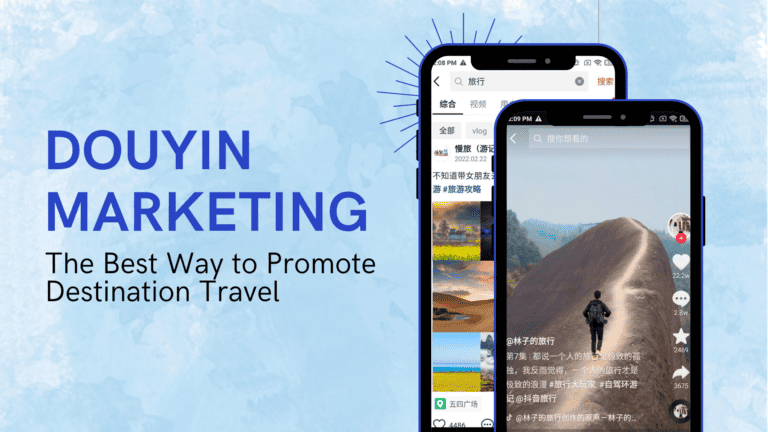
Douyin turns passive scrollers into travelers with a plan. A well-made 60-second video of your destination, your hotel pool at sunset or a local market can reach hundreds of thousands of Chinese users who have no idea your property exists. The algorithm pushes travel content to people who engaged with similar content before, so your video lands in front of people already thinking about a trip.
For small teams with limited resources:
- Produce 3 to 4 short videos per quarter showing your best visual experiences (500 to 2,000 USD per video)
- Partner with a travel KOL for a dedicated hosted stay (3,000 to 10,000 USD)
- Link your Fliggy listing in the Douyin bio so interested viewers can book directly
On a tight budget, the hosted KOL stay is the line I would cut first. The videos you own keep working.
Case Study: A Swiss Mountain Lodge Fills Its Off-Season via Fliggy
Lukas Steiner had run a mountain lodge in the Bernese Oberland for eleven years. Summer was always full. Hiking season brought Europeans and Americans like clockwork. November through February, almost empty. The property had 18 rooms, a sauna, and one of the best views of the Eiger north face in the region (the Eiger does a lot of the work, obviously). It should have been a winter destination. It wasn’t, except for the odd ski touring group.
A friend told Lukas that Chinese tourists were coming to Switzerland specifically to see the Alps in winter and that the snow-covered mountain look was extremely popular on Xiaohongshu. He had doubts. He was curious enough to contact CTA anyway.
CTA assessed the situation: zero Chinese-language presence, no Fliggy listing, no WeChat, no social media content in Mandarin. Chinese travelers had no way to find the property, book it or pay for it.
Phase one took three months. CTA built a Fliggy listing with professional winter photography. A Xiaohongshu account went live with two KOC-generated posts from travelers who visited in December, detailed stays covering the snowfall views, the wood-burning stove in the lounge, the fondue dinner and the sunrise over the Eiger. Both posts performed well. Combined saves: 19,000. One was shared in a major Xiaohongshu travel group focused on European winter destinations.
Phase two: Douyin. CTA produced two short videos from the KOC footage plus extra drone footage of the property in fresh snow. The better one reached 190,000 views in two weeks, shared mostly among users in their late 20s and 30s in first-tier Chinese cities (not teenagers, which matters for a lodge at 280 CHF a night).
Lukas set up WeChat Pay through a Swiss payment processor that supports Alipay and WeChat Pay for hotels. His reservation team downloaded WeChat and started answering inquiries in basic Mandarin, with CTA’s help on templates.
By the end of that winter season the lodge had hosted 41 Chinese guests: 112 room nights. Average spend per night: 280 CHF. Total revenue from Chinese guests that winter: approximately 31,360 CHF. Winter occupancy went from 12% to 29%. The following year Lukas booked double the Chinese guests, through a mix of Fliggy direct bookings and a partnership with a Shanghai-based travel agency.
“The Chinese guests were fantastic,” Lukas said. “They stayed longer, asked great questions about the history of the lodge, and they photographed everything. Two of them posted about us after they left and we got five more inquiries from their posts alone.”
One thing I would add to his setup. The listing cover shows snow. Come July, that same photo probably costs him clicks from summer hikers, and swapping the cover by season takes ten minutes.
Summary: Fliggy + Social Media = Your China Tourism Strategy
| Channel | Role in China Tourism | Budget Range |
|---|---|---|
| Fliggy | Booking platform, direct sales | Commission + setup |
| Xiaohongshu | Discovery and trust, KOC reviews | 3,000-8,000 USD/month |
| Douyin | Visual reach, destination inspiration | 500-2,000 USD/video |
| Guest communication and payment | 1,500-3,000 USD setup | |
| Baidu PPC | Search visibility | 1,500 USD/month min. |
Fliggy alone is not enough. The destinations and hotels that keep attracting Chinese tourists are present at several points of the journey: social content that inspires, reviews that reassure, and an OTA listing that converts. According to Mafengwo, properties that generate active Xiaohongshu content alongside their OTA listings see 2 to 3 times higher booking conversion rates from Chinese travelers than those relying on OTA listings alone.
If I had to keep one thing from all this, it would be the reviews. Lukas’s two guests who posted after leaving brought five inquiries on their own. Reviews do the selling.
How CTA Helps Tourism Brands Attract Chinese Tourists
- Douyin campaigns: video content, KOL partnerships, paid promotion
- Xiaohongshu KOC and influencer marketing for destinations and hospitality
- WeChat Official Account setup and Mandarin guest communication
- Baidu SEO and PPC for travel search visibility
- Chinese website and Mandarin landing page setup
- Full China digital strategy designed for small tourism budgets
Ready to list your destination or property on Fliggy and build the social presence around it? See how CTA can help you attract Chinese tourists.
Pedro Wang is the founder of Chinese Tourists Agency, an independent Shanghai agency specialised in Chinese travellers. A former CITS and Ctrip manager, he helps hotels, destinations and tourism SMEs reach Chinese travelers through Douyin, Xiaohongshu and WeChat.