White paper · October 2026
The New Chinese Traveller 2026
Who travels abroad from China in 2026, how they choose on Xiaohongshu, Douyin, WeChat, Zhihu and AI assistants, how they book and pay, and what hotels, tourism boards and attractions should do in the next 12 months. 17 pages, every figure dated and sourced.
Download the report (PDF, 17 pages)- 148.36 million outbound trips by mainland residents in 2025 (+20.8%), and slower growth in 2026 (+10.5% in H1).
- Japan −56.7%, South Korea +29%, Philippines +69%: visas and politics redraw the map.
- Five traveller profiles: Gen Z explorers, first-time flyers, premium long-haul, interest travellers, multi-country planners.
- Platform by platform: Xiaohongshu, Douyin and creators, WeChat and Zhihu, booking sites, AI travel assistants.
Read the report below or download the PDF. Questions: contact@chinesetouristagency.com.
Contents
About this report
What our team in Shanghai tracked through 2026: official border data, Ministry of Culture and Tourism figures, booking data from Trip.com, Tongcheng, Fliggy, Qunar and CYTS Aoyou, and platform data from Xiaohongshu, Douyin and WeChat.
Who it is for
Hotels, tourism boards, attractions, airlines, retailers and tour operators that receive Chinese visitors, or want to. Every figure is dated and sourced. Where data is missing, we say so.
Chinese outbound travel is no longer a rebound story. It is a new market with new rules.
Mainland residents made 148.36 million trips abroad in 2025, up 20.8%, and spent about 160 billion USD. In 2026 growth continues, but the traveller has changed. Five shifts matter most for tourism businesses.
Growth is slowing down
Border crossings by mainland residents rose 39.1% at New Year 2026, 10.2% at Spring Festival and 5.3% at Mid-Autumn. Volume alone will not fill rooms any more.
Visas and politics decide the winners
South Korea gained 29% (4.82 million visitors, January to August) while Japan lost 56.7%. New visa-free markets grow fastest: Philippines +69%, Türkiye +28%.
Two new crowds: Gen Z and smaller cities
Gen Z made 40% of Airbnb’s Golden Week outbound travellers. First plane tickets bought in tier-3 and smaller cities rose 40% in summer 2026 (Qunar).
Fewer, longer, richer trips
Multi-destination bookings rose 84% on Trip.com, with 2.8 countries per itinerary at Tongcheng. Premium and small-group order values rose about 20%.
The trip is decided on social search
Xiaohongshu counts 2.4 billion travel searches and more than 80% of its travel users read guides before choosing. Douyin users searched travel content 67.7 billion times in a year.
Our reading
The businesses that win in 2027 will not be the ones with the biggest ad budget. They will be the ones Chinese travellers can find, check and pay in their own apps.
The boom is over. Steady growth is here, and it no longer fills rooms on its own.
2025 was the catch-up year: 148.36 million trips, up 20.8%. In 2026 mainland exits still grow, 88.023 million in the first half (+10.5%), but each holiday adds less than the one before. Foreign visitors to China now grow faster than Chinese going out (+20.6% in H1).
Exhibit 1
Growth in border crossings by mainland residents, by 2026 holiday, % year on year
Jan 2026Spring Festival
Feb 2026 (daily average)Mid-Autumn
Sept 2026
Source: National Immigration Administration (NIA), holiday releases of January, February 24 and September 28, 2026.
~160bn USD
spent by Chinese outbound tourists in 2025 (China Tourism Academy)
2.15m
border crossings a day forecast for Golden Week 2026 (NIA)
+1.8%
international flights per week, summer-autumn 2026 schedule (CAAC)
So what? Flight capacity barely grows, so demand will not rise for everyone. Destinations will win share from each other. The job moves from “be visible” to “be chosen”.
Visas and politics redraw the map faster than any campaign.
After the diplomatic tension of November 2025, Japan lost about 3.81 million Chinese visitors in eight months, and South Korea took its place. Countries that removed visas in the last twelve months grow fastest. A first trip abroad goes where no embassy appointment is needed.
Exhibit 2
Chinese visitor arrivals, 2026 year to date, % change year on year
Sources: Philippine Department of Tourism (preliminary), Korean tourism data (Sept 28), Türkiye tourism agency via Xinhua, TASS, BPS Indonesia, Thai Ministry of Tourism and Sports, Tourism Malaysia, Singapore Tourism Board, JNTO (Sept 16). Periods differ by country.
Long-haul surprises
Spring Festival 2026: flight tickets to Brazil up 190%, Türkiye more than doubled, orders to Oman and Kazakhstan up over 200%. Italy tickets rose almost 200% during the Milan Cortina Olympics.
Events move people
UTour reported travellers to North America up 135% for summer 2026, driven by the World Cup. Concerts in Seoul made K-pop trips one of the year’s top outbound trends.
“The Chinese tourist” no longer exists. Five profiles now drive the market.
Gen Z explorers
born after 1995, in twos and threes
40% of Airbnb’s Golden Week outbound travellers. Nearly 95% book activities, not only hotels and flights; 60% name an “authentic local experience” as a top factor.
Xiaohongshu notes, travel creators, bookable experiences
First-time flyers
tier-3 cities and below
“First plane ticket” purchases up 40% in summer 2026 (Qunar). Outbound bookings from Yining +216% and Yuncheng +134% (Tongcheng). Over 87% of Tongcheng users live outside tier-1 cities.
OTA packages, Douyin, short-haul visa-free offers
Premium long-haul
older, families, small groups
Average order value at CYTS Aoyou up 20.18% for National Day 2026, with Europe at about 61% of its outbound orders. Tongcheng saw 20% higher spend per person on small-group and custom trips.
Tour operators, WeChat, Chinese-speaking service
Interest travellers
fans, wellness, nature, sport
The Xiaohongshu tag #跟着兴趣去旅行 (“travel by following your interest”) passed 1.7 billion views. K-pop trips to Korea: 70 to 90% women in their twenties, mostly independent.
Fan communities, niche creators, event calendars
Multi-country planners
one trip, several borders
Multi-destination bookings up 84% on Trip.com; 2.8 countries per itinerary at Tongcheng. National Day hotel orders for combos like “Singapore + Malaysia” grew 1.2 times.
Regional partnerships, joint offers with neighbours
So what? Pick one or two profiles and build for them. A message that tries to please a 22-year-old fan and a 60-year-old couple on a Europe tour reaches neither.
Search moved into social apps. The trip is chosen before any booking site opens.
Exhibit 3
Average daily searches by app, China, Q1 2025
Source: QuestMobile data reported by The Paper; Xiaohongshu May 2026 figure reported by Huxiu. Counting methods differ by platform.
A typical 2026 decision path
1
Spark
A Douyin video shows a lake, a dish, a concert.
2
Research
Xiaohongshu guides and real notes from other travellers.
3
Check
Baidu, an AI assistant, Dianping reviews.
4
Book
Trip.com, Fliggy, Tongcheng or inside Douyin.
5
Share
A note or review that sparks the next trip.
230m
monthly Xiaohongshu users interested in travel, 2.4bn travel searches
80%+
of its travel users read guides before choosing a destination or hotel
67.7bn
hotel and travel searches on Douyin in one year (Douyin 2026 report)
So what? If a traveller cannot find you at step 2 or 3, your listing at step 4 never gets the click. Use one Chinese name everywhere and answer the questions people search.
Xiaohongshu is the travel advisor. Hotels, tourism boards and agencies now sell where the trip is planned.
On Xiaohongshu (RED, RedNote) travellers read real notes before they choose a city, a hotel or a restaurant. A Q1 2026 survey quoted by China Tourism News found 54.4% use it to explore outbound itineraries, ahead of travel apps at 46.8%.


230m
monthly users interested in travel
2.4bn
travel searches
80%+
of travel users read guides first
520k
travel creators with 1,000+ followers
Who uses it professionally
Hotels
Brand accounts, guest notes, room tours and booking links. The note ranks on the hotel name for months.
Travel agencies
Itinerary notes, small-group offers and private messages that turn into quotes.
Tourism boards
In May 2026 the Singapore Tourism Board signed an MOU with Xiaohongshu Business.
So what? Treat Xiaohongshu as a search engine: titles with the words people type, real guests, declared partnerships. The platform removes bought notes and fake travel accounts.
Douyin creates the desire. Creators and livestreams turn it into bookings.
Douyin is the awareness machine: more than a billion monthly users, and 51.5% of outbound travellers use it to explore itineraries. It is also a search engine and, more and more, a place to book.


1.009bn
monthly users, March 2026
67.7bn
hotel and travel searches in a year
+75%
spending inside scenic-spot livestreams
32%
of Douyin hotel bookers bought in a livestream
Working with creators (KOLs) on Douyin
Pick audience, not size
A fan account with 8,000 to 40,000 followers can be trusted more by its niche than a generalist with ten times more.
Three formats that sell
A creator visit video, a livestream with vouchers, and a complete POI page that both point to.
Follow the rules
Paid posts must be declared and claims must be true. Words like “the best” can bring a fine.
So what? Use Douyin for reach and for the offer, Xiaohongshu for the decision. A video titled with a real search query keeps working for months; a trend video fades in a week.
WeChat keeps the relationship. Zhihu answers the hard questions.

WeChat · 1.439bn monthly accounts
Articles as a newsletter. Official Account articles reach the people who already follow you: past guests, travel agents, partners. This is where repeat guests and the trade read you.
Channels. Short videos spread through friends’ likes, which suits older and family travellers.
Search and AI. WeChat search finds articles, Mini Programs and services. Its AI search had 160 million monthly users by June 2025.
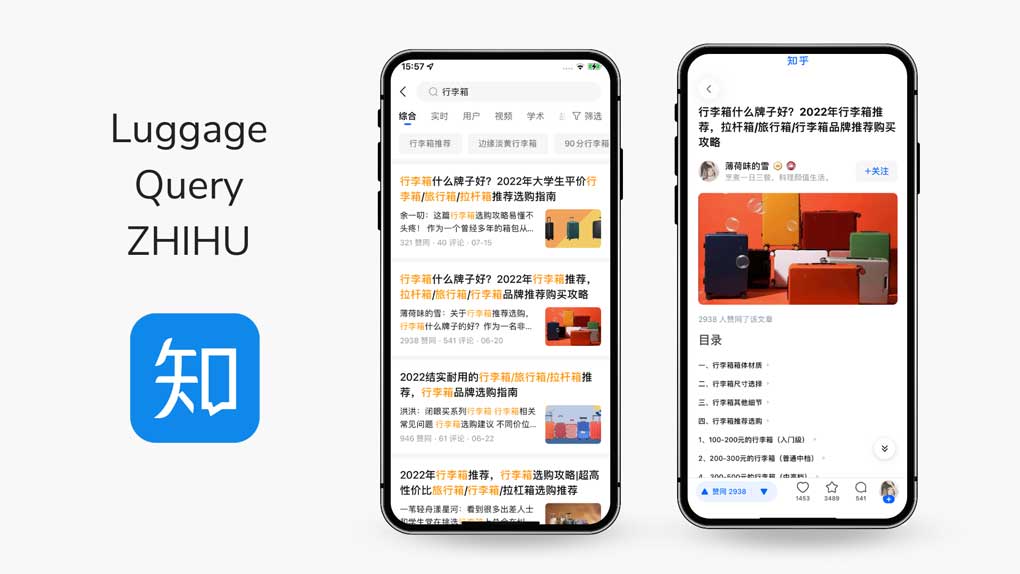
Zhihu · the deep research step
Zhihu is China’s question and answer site. Travellers go there for questions a short video cannot answer: visas, safety, budgets, “country A or country B”.
Threads such as “UK visa is easier than Schengen now” or “Canada vs Australia” shape long-haul choices. Upvoted answers rank on Baidu for years, and AI assistants read them.
WeChat in practice
A verified Official Account, two useful articles a month, a booking Mini Program, fast answers in Chinese.
Zhihu in practice
An organisation account, expert answers to real questions about your destination, no mass posting.
Booking sites close the sale. They rarely start it.
The decision happens in the feed; the payment happens on an online travel agency (OTA). A complete Chinese listing is the minimum: photos, room names, policies, payment logos, answered reviews.

So what? List on Trip.com first, add Fliggy or Tongcheng for your target profile, claim your Dianping page, and give tour operators a Chinese sales kit.
The next travel agent is an AI. It only recommends what it can read in Chinese.
Chinese travellers now ask Doubao, DeepSeek, Yuanbao, Baidu’s ERNIE assistant or the assistants inside Ctrip and Fliggy to build an itinerary, compare hotels or explain a visa. The answer comes from Chinese content those tools can find.
60%+
of 3,000 Chinese travellers used AI for travel decisions in 2025 (TravelDaily and Digital100 survey)
200m
monthly users of Baidu’s ERNIE assistant, January 2026 (Baidu)
160m
monthly users of WeChat AI search, June 2025 (QuestMobile)
What AI assistants read before they answer
How to be in the answer (GEO)
- One Chinese name and the same facts everywhere
- Pages that answer one real question each
- Dates, prices, addresses an AI can quote
- Presence on Baike, Zhihu and trusted media
- Monthly check of what the assistants say about you
The trap to avoid
In March 2026, CCTV’s 3·15 show exposed GEO firms that fed AI models with invented articles: in a test, a product that did not exist ended up near the top of two AI models’ recommendations. Platforms and regulators are now watching. Publish only true information under your own name.
Our view for 2027
Ask, compare and book will happen in one conversation, inside the apps travellers already use. Businesses that are clear, consistent and present in Chinese sources will be recommended. The others will simply not be mentioned.
The phone is the wallet. Payment is the last step of the trip, and the one guests remember.
At home, Chinese travellers pay almost everything with Alipay or WeChat Pay. Abroad they look for the same logos, then UnionPay. A card-only terminal is friction, and it often shows up in the review.
1.439bn
monthly active Weixin and WeChat accounts, Q2 2026 (Tencent)
150m+
merchants worldwide on the Alipay+ network, over 2bn accounts (April 2026)
183
countries and regions accept UnionPay, at 100m+ overseas merchants
Exhibit 4
Growth in Chinese payment activity abroad, National Day holiday 2026, % year on year
Sources: UnionPay International and Tenpay holiday releases, reported by Guangming Daily, October 8, 2026. Mainland departures over the holiday: 4.444 million, up 9.3% (NIA).
What guests expect
Alipay and WeChat Pay at the counter, prices clear in yuan or with a converter, tax refund that works on the spot.
What most businesses miss
Saying it. If your Chinese listing or Xiaohongshu note does not show the payment logos, travellers assume you do not take them.
Six moves for the next 12 months
Ordered by cost and speed. The first three cost little and pay back within one season.
01
Fix your Chinese name and facts
One Chinese name on Trip.com, Dianping, Xiaohongshu, Baidu and maps. Same address, same photos, same prices. AI assistants and search engines connect what matches.
02
Show that you take Chinese payments
Accept Alipay and WeChat Pay, then put the logos in every Chinese listing and post. It is the cheapest conversion gain on this list.
03
Answer reviews in Chinese
Chinese travellers read the last reviews before booking. A fast, polite answer in Chinese protects the next ten bookings.
04
Build for one or two profiles
Gen Z explorers want bookable experiences and photo spots. Premium long-haul guests want small groups and Chinese-speaking service. Choose, then design the offer.
05
Be searchable on Xiaohongshu and Douyin
Notes and videos titled with the words travellers type: your city plus “family hotel”, “worth it”, “visa-free”. Real guests and declared partnerships only.
06
Partner across borders
With 2.8 countries per itinerary, your neighbour is a partner. Joint offers and shared routes catch the multi-country planner.
Next 30 days
Search your name in Chinese on Baidu, Xiaohongshu and Douyin. Write down what a guest sees.
Before Spring Festival
Chinese New Year 2027 falls on February 6. Content must be live 6 to 8 weeks before.
Measure
Inquiries, bookings and cost per lead. Views come last.
The full white paper: 36 pages, 8 chapters, 20 exhibits
Method
Official statistics first, then booking platforms, then social platforms. Each figure carries its source and date. Holiday comparisons use the same calendar period. Platform figures are self-reported and counted differently; we show them as given, without adding them up.
Main sources
National Immigration Administration · Ministry of Culture and Tourism · China Tourism Academy · CAAC · JNTO, Korean, Thai, Malaysian, Philippine tourism bodies · Trip.com, Tongcheng, Fliggy, Qunar, CYTS Aoyou, UTour, Airbnb · Xiaohongshu, Douyin, Tencent, UnionPay, Ant Group · QuestMobile · Chinese press (Guangming Daily, The Paper, 21st Century Business Herald, Huxiu).
About the authors
This paper was written in Shanghai by the team that runs Chinese campaigns for hotels, tourism boards and attractions every day.

Pedro Wang
Founder, Chinese Tourists Agency
Pedro spent ten years inside the Chinese travel industry before opening the agency in 2012: six years at CITS, China’s largest state travel operator, then four at Ctrip, on hotel acquisition and destination campaigns. He has run destination campaigns on Xiaohongshu since 2018 and oversees every client strategy.
“Search your name in Chinese and read what comes up. That is what your next guest sees.”

Alex Wu
Project manager, Chinese Tourists Agency
Alex runs day-to-day campaigns for international hotels and tourism boards from the Shanghai office: Xiaohongshu and Douyin content, creator partnerships, Chinese listings and monthly reporting. Bilingual, he is the contact clients call when they need an answer the same day.

A team of 30 across China
Content writers, media buyers, creator managers, designers and account managers, led from Melody Square, Jing’an, Shanghai.
Questions about this paper: contact@chinesetouristagency.com
About Chinese Tourists Agency
Chinese Tourists Agency is an independent agency based in Shanghai. Since 2012 we have worked on one thing: bringing Chinese travellers to hotels, destinations, attractions, restaurants and shops around the world.
2012
founded in Shanghai
30
specialists across China
1
market: Chinese travellers
What we do
Xiaohongshu and Douyin marketing · WeChat accounts and Mini Programs · Baidu and AI search (GEO) · Chinese reviews and reputation · representation for tourism boards · trade shows, fam trips and press in China
“Search your name in Chinese on Baidu, Xiaohongshu and Douyin, and read what comes up. That is what your next guest sees.”
Pedro Wang, founder (six years at CITS, four at Ctrip)
Shanghai office
Room 101, Building 8, Melody Square
No. 1220 Jiangning Road, Jing’an, Shanghai
上海市江宁路1220弄音乐广场8号楼101
Contact
contact@chinesetouristagency.com
chinesetouristagency.com
Free China visibility audit on request
© 2026 Chinese Tourists Agency. Figures as of October 2026, sources on page 15. You may quote this paper with a link to chinesetouristagency.com.