
+98% of Chinese tourists in Turkey
2018 is going to be a good year for Turkey. Indeed, 2018 has been designated as “Turkey Tourism Year” by China. According to Turkey’s General Directorate of Investment and Enterprises, in the first quarter of this year, Chinese tourism has doubled in year-over-year terms, up 98 percent bringing a total of almost 125,000 Chinese tourists in just four months.
The relationship between Turkey and China

The Turkish government wants to improve tourism ties between Turkey and China. Numan Kurtulmus, the Turkish Culture and Tourism Minister said during a visit to Beijing that China will soon become one of Turkey’s “most important” tourism partners. “Around 250,000 Chinese tourists came to Turkey last year. There is no reason not to increase this number to 500,000.” The Turkish Foreign Ministry added that he considers tourism a key factor for improving its relationship with China. He also said that 2018 will see last year’s $26 billion tourism revenue reach $32 billion.
Tourism in Turkey

A leading tourism player from the Aegean province of Denizli, where Pamukkale is located with its iconic white travertine stones, said up to 95 percent of Chinese tourists visiting Turkey came to Pamukkale. Other popular destinations for Chinese tourists are Istanbul and Cappadocia. The latter attracted more than 250,000 Chinese tourists in 2017, aiming to draw 500,000 this year. Tourists in the city, which is part of UNESCO’s World Cultural Heritage List, marvel at its outlandish landscape, enjoy horse riding, all-terrain vehicle and hot balloon tours. Tourists can also visit the Göreme Open Air Museum, Paşabağı, the Zelve Ruins, Derinkuyu and the Kaymaklı underground cities.
How to attract more Chinese tourists in Turkey?
Chinese tourists have high expectations in international tourism by selecting their travel agency online. In China, 80% of booking reservations are realized online. Therefore, accessing Chinese consumers online is the best way to reach them and generate traffic to your website and have potential customers in contact with your company.
Increase your visibility with SEO on Baidu

SEO on Baidu is the key for the visibility of your business in China. Baidu is the most used search engine in China, it ranks 5th mong the most visited sites in the world and currently has more than 800 million web pages. Baidu now offers a wide range of services, such as web searches, image search, music, forums or a Q&A service. SEO on Baidu requires several steps, which may be different from what needs to be done on Google. The notions of trust and notoriety remain essential for schools wishing to enter the Chinese market and be visible on Baidu. Key SEO strategies include keyword optimization, backlinks, and content sharing, this is the way to generate quality traffic. Compared with SEA, SEO takes more time, but it is long term solution in terms of developing a better e-reputation and is ultimately more stable. The quality search result won’t disappear after you stop the campaign, on the contrary, you will remain higher in the rankings and continue to drive traffic.
A Chinese website
A website in Chinese is necessary to enter a market and realize branding. This is an efficient solution to increase the popularity of your products, influence consumers with content and design, and develop the image of your company in the country. Moreover, having a website written in mandarin is essential. Chinese consumers spend more than 40% of their daily life on Internet and these internet users trust more Chinese websites than English websites.
E-reputation and online public relations

Having a good reputation online is essential in China. Public Relations is one of the key points on which any digital marketing strategy should be based. More than attract Chinese travelers to your website, it is important to raise your company awareness and to make it more visible for Chinese by using online Public Relations. Chinese internet users spend more than 40% of their spare time on the internet, therefore, you should favor online public relations.
Video advertisement
The ratio of smartphone users in China has been increased tremendously. Last year, digital ad spending in China reached $40.42 bn, a 30% increase on the previous years’ spending. Ad spend in China is expected to reach over $80 bn by 2020. The numbers speak for themselves, this is a lucrative arena in terms of spend and return on investment. Chinese people like to watch videos on smartphones and you can develop unique ideas to spread your brand awareness campaigns through effective video messages. Advertising in China is however a very unique eco-system that requires a different approach, understanding and mind-set. When it comes to ad spending you have to understand not only the most popular platforms in terms of user number but also, and most importantly, the infrastructure each platform has for advertising services.
Social media

China is the world largest connected country: more than 90% of Chinese people have an account on at least one Chinese social network. Wechat is the social media the most used in China and, regardless of the size of your company, it is an essential media to develop your marketing strategy in the country. By promoting your products on social media, you can build a community surround your company, reach your target, get feedback and create a friendlier company image. Sina Weibo, China’s largest SNS so far, has got a nearly 88% penetration rate among the nation’s excess 358 million users. It has also attracted over 130,000 companies including one-third top 500 enterprises in the world. They don’t just join Weibo on impulse, but for the benefit Weibo can bring them. Some come to Weibo for brand awareness, some for brand image and others for closer relationship with customers.
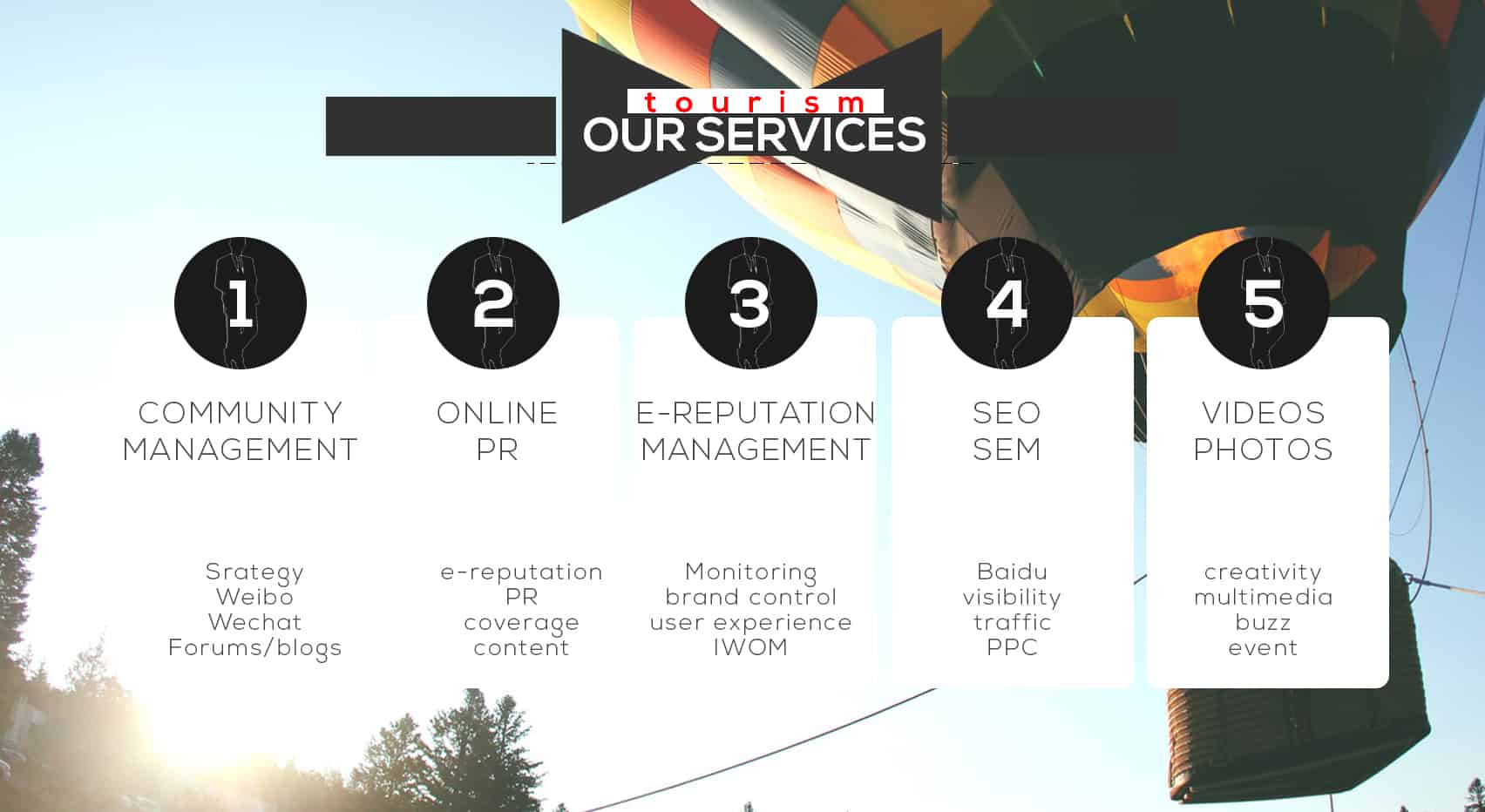
If you are struggling to enter the Chinese market, a digital marketing agency is your best choice. Do not hesitate to contact us for more information!
Read also:






Glory royal Sahara clamping holiday package offers you total privacy in a stunning location in Morocco Getting away from it all takes on a whole new meaning when you look out of your tent and can only see the Sahara Desert stretching before you.
One or more of our fully-furnished royal Tent Suites can be set up for your personal stay in a beautiful setting, with a team to look after your every need.
For a Honeymoon or simply a private stay or a small group activity, we can provide you with all the luxuries as the camp, fully serviced and with a range of bespoke activities.